Monday, June 12, 2006

Former prisoners: no hope at Gitmo

From the AP:
Three British youths formerly detained at the U.S. military prison in Guantanamo Bay and now the subjects of a new film about their experiences say they were driven to desperation knowing others had tried to kill themselves at the camp.

In an interview with The Associated Press, Shafiq Rasul and his two friends—Ruhal Ahmed and Asif Iqbal—describe how they were held at Guantanamo for more than two years without charge. Many of the some 460 detainees accused of links to Afghanistan’s Taliban regime or the al-Qaeda terror network have been held for more than four years without charge.

“There is no hope in Guantanamo. The only thing that goes through your mind day after day is how to get justice or how to kill yourself,” Rasul, 29, who waged a hunger strike at the camp to protest beatings, said Saturday. “It is the despair—not the thought of martyrdom—that consumes you there.”
[+] Add to your del.icio.us.

If you wish to read the AP article 30 days from now, you should save it on your computer. In Firefox, press Cmd+S (OS X) or Ctrl+S (Windows) on your keyboard and choose the location to save the article.

Sunday, June 11, 2006

The problem with the pledge

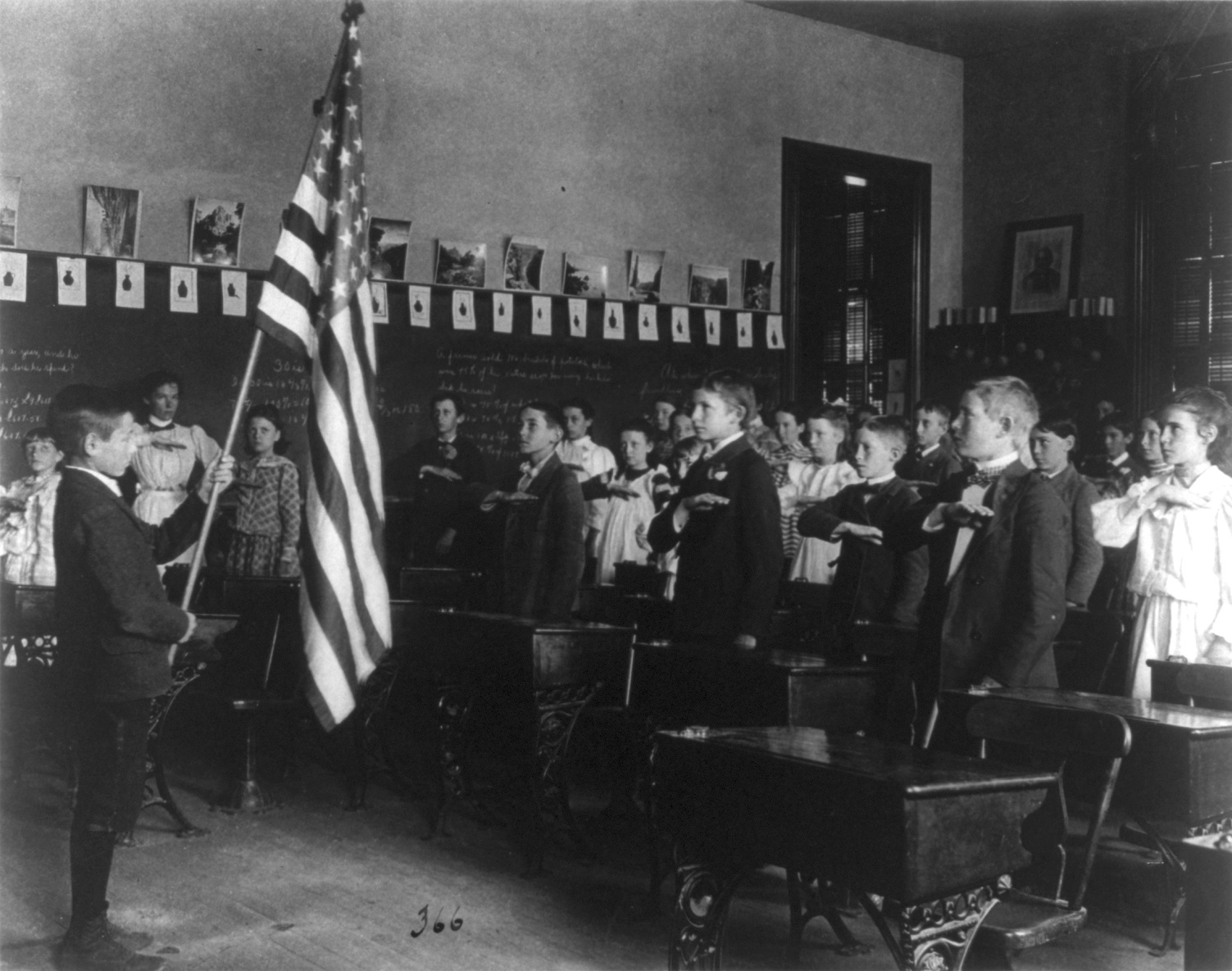
On September 7, 1892, the United States pledge of allegiance was penned and published by Francis Bellamy. About a month later, on October 12, 1892, the pledge was first recited in public schools. And since that day, it has been recited by millions of Americans in school, at sporting events, national ceremonies, and even churches. Reciting the pledge is regarded as a patriotic activity that all Americans should participate in.

But while the pledge might give every “patriotic” American a warm, fuzzy feeling in their hearts, what they don’t realize is what they are actually saying when they recite the pledge.

Before I delve into that, however, I would like to take a look at the pledge’s history.

Francis Bellamy was born on May 18, 1855 to a Baptist minister. Bellamy himself grew up to become a Baptist minister—and a socialist. (You might know the name Bellamy because of his brother Edward Bellamy, who wrote the sociliast-utopian novels Looking Backward and Equality.)

In 1888, family-oriented magazine Youth’s Companion began selling American flags to public schools. Three years later, the magazine hired Francis Bellamy to promote the selling of the flags by writing a pledge for their advertising campaign. The pledge “was marketed as a way to celebrate the 400th anniversary of Columbus arriving in the Americas and was first published on the following day.”1

The pledge was written to promote national unity in the United States.

In other words, the pledge was written to condition the people to the idea that the national government was supreme over the states. The states had little—if any—rights. The states could not secede. The nation was one.
...and to The Republic for which it stands, one Nation under God, indivisible, with liberty and justice for all.
One Nation...indivisible. Do you realize what that means? The union cannot be dissolved! The union is not a loose joining of the states which they can remove themselves from at any time! The union is the states’ abdication of their rights! Because they decided to pool their resources for defense and an overseeing board, if you will, they lost their rights.

But while the indivisibility of the union is absurd, there is an even more incredible, outrageous, and downright frightening concept.
I pledge allegiance to the flag of the United States of America, and to The Republic for which it stands....
I pledge allegiance to the flag...and to The Republic for which it stands. Do you realize what you’re saying when you say that? You’re pledging your allegiance to a symbol—the flag—and to the government that brandishes said flag. You are giving your allegiance to Leviathan! Leviathan taxes you, you pay the taxes with little or no complaint. Leviathan goes to war, you support the war by speaking for it or by fighting in it. Leviathan murders an innocent, you ignore it. You cannot disobey, deny, or fight Leviathan. Leviathan owns your property, your body, your mind.

Christians have one—and only one—to whom they owe allegiance: Jesus Christ. They are not to give their allegiance to their government. While they are to obey their government, they are to obey it only when doing such is in accord with the Bible.

When you pledge allegiance to the government, you are basically saying that you will support it no matter what it does and no matter what it costs you—even if it’s your very life.

[+] Add to your del.icio.us.

Images are in the public domain and thus are not copyrighted.

1http://en.wikipedia.org/wiki/Pledge_of_Allegiance#History

Saturday, June 10, 2006

U.S. court backs government broadband wiretap access

A U.S. appeals court on Friday upheld the government’s authority to force high-speed internet service providers to give law enforcement authorities access for surveillance purposes.
Thank God they upheld the government’s authority: Now the Feds will be able to protect us from terrorists!
The U.S. Court of Appeals for the District of Columbia Circuit rejected a petition aimed at overturning a decision by regulators requiring facilities-based broadband providers and those that offer Internet telephone service to comply with U.S. wiretap laws.
Those who submitted the petition will probably be the first to have their communications monitored.
In a split decision, two of three judges on the panel concluded that the 2005 FCC requirement was a “reasonable policy choice” even though information services are exempted from the government’s wiretapping authority.
Of course it was a “reasonable policy choice”: It expands the government’s power.
The FCC has set a May 14, 2007, deadline for compliance, and the ruling drew praise from the FCC and the Justice Department, which sought the access.

“Today’s decision will ensure that technology does not impede the capabilities of law enforcement to provide for the safety and security of our nation,” the department said in a statement.
Because the right to privacy is a barrier to keeping the country safe. Oh, wait. No, it’s not. The Justice Department is using a tactic we in the tech world like to call FUD. FUD stands for “Fear, uncertainty, doubt,” and refers to the tactics companies employ in order to keep people from buying their competitors’ products.

The Justice Department is using FUD in order to convince people that privacy is not a right, that privacy is not necessary, that privacy is a barrier to their safety.

Sadly—and to the detriment of liberty in the United States—the Justice Department’s FUD has convinced many.

[+] Add to your del.icio.us.

Sunday, June 04, 2006

(PHOTO) The beach

Boardwalk Beach Resort

This photo was taken in Panama City Beach, FL in June 2005, probably between June 5 and June 9. Well, I’ll be gone again this year from June 6–9, and I won’t have internet access, so there won’t be any updates till Saturday, June 10.

[+] Add to your del.icio.us.
[+] Add photo to your del.icio.us.

Toronto mosque vandalized after terrorism arrests

Vandals smashed 30 windows of a Toronto mosque and damaged nearby cars after the arrest of seventeen suspected al-Qaeda sympathizers accused of planning bomb attacks. Canadian Muslims expressed fear on Sunday that a backlash had begun.

The vandals struck overnight at the west-end mosque, a police official said on Sunday. A second official said he had no information on any link between the incident and the arrests, which began late Friday.

“The actual weapon that was used to break [the windows] is unknown,” said secretary Ameer Ali of the International Muslims Organization of Toronto, which houses the mosque. “We believe it has to be a heavy instrument, possibly a sledgehammer or a pick ax, or it could even be a crowbar.”
That’s a shame that someone would vandalize a mosque. It’s not as if all Muslims are bad and violent. (Besides, whatever happened to freedom of religion?) Vandalizing a religious building because some of the people practicing the religion promoted there are violent makes about as much sense as assaulting a black man because another black man attacked you three months ago.

If someone vandalized a church, I would be equally upset. Yes, I am a Christian, but that isn’t the only reason why I’d be upset. The other reason is that the church is private property (the property of the people who run the church), and property should not be vandalized unless permission is given—which would be rather odd.

[+] Add to your del.icio.us.

Saturday, June 03, 2006

Congress sets its sights on video games

CNET News has an article about Congress’s video-game conviction:
The purported problem of violent and sexually explicit video games has resurfaced on politicians’ agenda as the November election draws near.
What about violent and sexually explicit films?
A U.S. House of Representatives committee on consumer protection says it will hold a hearing on the topic later this month, with a focus on “informing parents and protecting children” from the alleged dangers of those types of games.
I think the House is a tad late on “ ‘informing parents and protecting children’ from the alleged dangers of those types of games”—twelve years too late, as a matter of fact. The ESRB has been rating video games since it was established in 1994.

All else aside, it is not the job of Congress to legislate video games. Nowhere in the Constitution is Congress given the authority to regulate any form of entertainment. (Yes, people had entertainment in the 1700s: the theater, etc.) The States, however, are given such authority under the Tenth Amendment: Since Congress cannot legislate entertainment, the States—or their counties, districts, or cities—can.

Of course, the Constitution’s text will be summarily ignored, and Congress will pass regulations on video games. Supporters of Congress’s actions will duly ignore the ignorance Congress gives movies and praise the legislation as “moral,” “good for freedom,” and “the American thing to do.”

What is the American thing to do, anyway? Judging by all the wars we’ve waged, I’d say the American thing to do would be to bomb the video game developers and publishers.

[+] Add to your del.icio.us.

Friday, June 02, 2006

NSA has complete access to all phone-company data

The New Yorker posted a rather ominous story on May 22—a story I didn’t find out about till today over at Politipop.

Here are the first three paragraphs:
A few days before the start of the confirmation hearings for General Michael Hayden, who has been nominated by President Bush to be the head of the C.I.A., I spoke to an official of the National Security Agency who recently retired. The official joined the NSA in the mid-nineteen-seventies, soon after contentious congressional hearings that redefined the relationship between national security and the public’s right to privacy. The hearings, which revealed that, among other abuses, the NSA had illegally intercepted telegrams to and from the United States, led to the passage of the 1978 Foreign Intelligence Surveillance Act, or FISA, to protect citizens from unlawful surveillance. “When I first came in, I heard from all my elders that ‘we’ll never be able to collect intelligence again,’” the former official said. “They’d whine, ‘Why do we have to report to oversight committees?’ ” But, over the next few years, he told me, the agency did find a way to operate within the law. “We built a system that protected national security and left people able to go home at night without worrying whether what they did that day was appropriate or legal.”

After the attacks of September 11, 2001, it was clear that the intelligence community needed to get more aggressive and improve its performance. The Administration, deciding on a quick fix, returned to the tactic that got intelligence agencies in trouble thirty years ago: intercepting large numbers of electronic communications made by Americans. The NSA’s carefully constructed rules were set aside.

Last December, the Times reported that the NSA was listening in on calls between people in the United States and people in other countries, and a few weeks ago USA Today reported that the agency was collecting information on millions of private domestic calls. A security consultant working with a major telecommunications carrier told me that his client set up a top-secret high-speed circuit between its main computer complex and Quantico, Virginia, the site of a government-intelligence computer center. This link provided direct access to the carrier’s network core—the critical area of its system, where all its data are stored. “What the companies are doing is worse than turning over records,” the consultant said. “They’re providing total access to all the data.”
It’s not the least bit surprising that the NSA has access to whatever information it wants whenever it wants. The day The New York Times broke the warrantless wiretapping story, I knew that the government’s surveillance stretched far beyond what we were told.

If I’m doing nothing wrong, I have nothing to fear, right? I guess so, but would you really want to be under surveillance while you and your wife are having sex? Would you want the government to listen in on your conversations—especially if the topic was politics and you weren’t exactly supporting the government?

I think not.

[+] Add to your del.icio.us.
[+] Add the New Yorker article to your del.icio.us.

Thursday, June 01, 2006

Source: FBI wants internet records kept for two years

The Federal Bureau of Investigation wants U.S. Internet providers to retain Web address records for up to two years to aid investigations into terrorism and pornography, a source familiar with the matter said on Thursday.
Provided that they tell me they’re doing so, I don’t care if the ISPs keep the records of their own volition and for internal—i.e., their own—purposes.

I
do care when the government forces them to do such.
The request came during a May 26 meeting between U.S. Attorney General Alberto Gonzales and FBI Director Robert Mueller with top executives at companies like Google, Microsoft, and AOL.

“I think there is less of a willingness to passively go along with this type of request than there might have been a year ago,” said the source, mentioning the recent uproar over a report that telephone companies had provided call records to the National Security Agency.
I think there is more of a willingness to happily comply with this type of request than there definitely was before 9/11.
A Justice Department spokesman confirmed the meeting but was not immediately available to comment on how long law enforcement officials wanted the records retained.
What a surprise.
“This meeting was an initial discussion for the Attorney General to gather information and to solicit input from Internet service provider executives on the issues associated with data retention,” said spokesman Brian Roehrkasse.
Input that will be ignored unless it’s what Gonzales and the Feds want to hear.
The source, who spoke on condition of anonymity, said Gonzales presented blurred images of child pornography and explained why he thought retaining data was important to those investigations. At issue were IP addresses.
The it’s-for-the-children card is to make those who oppose the government’s coercion appear to be child-haters or child molesters or something equally horrible.
When one industry executive questioned how long the government wanted the records kept, Mueller said for two years and that the data would also be used for anti-terrorism purposes, said the source.
Just like monitoring Americans’ phone calls is “for anti-terrorism purposes.” One day, I suppose, video surveillance of the interior of every American’s house will be “for anti-terrorism purposes” as well.

[+] Add to your del.icio.us.